
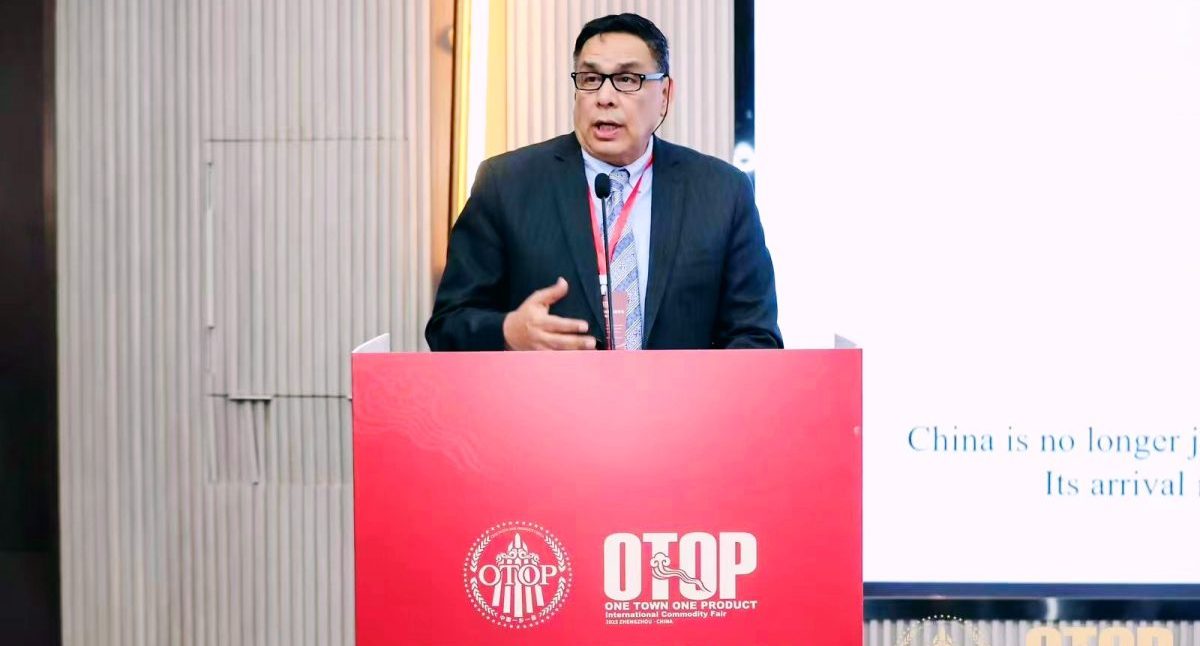
Héctor Villagrán
Profesor de Estudios Latinoamericanos de la Universidad de la Lengua y Cultura de Beijing (BLCU). Director del Centro para Diálogo Civilizacional China-ALC del Centro Mundial de Sinología de BLCU. Máster en Derecho Chino de la Universidad de Tsinghua. Abogado de la Universidad de Guayaquil. Ex Ministro de Transporte y Obras Públicas del Ecuador y Ex Representante de Comercio e Inversiones del Ecuador en China.

Discurso pronunciado durante la «One Town One Product International Cooperation Forum 2025» celebrado el 26 de noviembre en la ciudad de Zhengzhou, Provincia de Henan.
Good morning/afternoon. Thank you for the invitation to speak. Today, I’ll briefly explain how cross-border trade between China and Latin America has evolved over the last decade, why it matters for the Belt and Road Initiative, and what the main opportunities and risks are for Latin American countries.
Over the past twenty-five years, China has gone from a marginal trading partner for Latin America to one of the region’s largest economic partners. Two decades ago China–Latin America trade measured in the low tens of billions of dollars; by 2020, it had already surpassed three hundred billion dollars, and in 2024 bilateral trade reached a record level of roughly US$515–518 billion. This illustrates how the two regions have become increasingly integrated—particularly in the trade of commodities such as soy, copper, and oil, as well as manufactured goods flowing in the opposite direction. Why does this matter for the Belt and Road? China’s Belt and Road Initiative (BRI) frames infrastructure, finance, and regional connectivity as central pillars. In Latin America, BRI-related engagement has often focused on ports, rail, energy, telecommunications, and industrial logistics — projects that reduce trade costs and can help integrate exports into global value chains. For countries pursuing export growth, better ports, roads, and energy capacity can be transformative. Recent Chinese finance packages and credit lines to the region — including the multi-billion dollar RMB credit announcements in 2024–2025 — show Beijing’s continuing interest in supporting infrastructure and trade corridors.
Let’s look at trade and investment patterns over the last decade. Trade rose sharply in the 2010s, slowed and reoriented during the COVID shock, and recovered strongly afterward. In 2024, the region exported large volumes of agricultural and mineral commodities to China (soybeans, copper, oil, foodstuffs), while importing manufactured goods, electronics, machinery, and telecom equipment — a classic complementarity pattern. This composition has important implications: Latin America earns foreign exchange from commodity exports, but faces the challenge of moving from raw-material dependence to higher value-added exports.
On investment, Chinese direct investment into Latin America grew significantly in the 2010s — helping finance mines, energy projects, and infrastructure. More recently, the annual flows have been uneven. Official and monitored estimates show Chinese direct investment in LAC in the low-to-mid tens of billions in 2024 (around US$14.7 billion reported by Chinese sources), concentrated in sectors such as energy, mining, transport, and telecommunications. At the same time, Chinese investment remains smaller than flows from traditional investors (EU, U.S.) in absolute stock terms, though it is strategically important for particular projects and countries.
Another important dimension of China–Latin America cooperation, which is often overlooked, is the flow of Latin American investment into China. While this flow is smaller than Chinese investment in our region, it is increasingly strategic and reveals how Latin American companies see China not only as a buyer, but as a long-term partner.
According to China’s Ministry of Commerce, by March 2025, Latin American firms had established around thirty-seven thousand enterprises in China. This number is remarkable. It shows that our companies are not simply exporting raw materials, but are actually present on the ground, building factories, forming partnerships, and integrating into Chinese value chains.
In terms of investment value, Latin America accounted for 1.4 percent of newly established foreign enterprises in China in 2023, yet contributed 6.4 percent of the actual foreign investment amount. This means that although the number of new companies is relatively small, the projects Latin America chooses to invest in are high-value and capital-intensive.
A clear example is Brazil’s WEG, a multinational specializing in industrial equipment. WEG operates multiple factories in China, employs several thousand workers, and continues to expand. The company recently invested more than 1 billion yuan in its Chinese operations, including robotics and automation upgrades that increased productivity by 40 percent. Other examples include companies like Embraer, Vale, Petrobras from Brazil, LATAM airlines and CODELCO from Chile, Grupo Bimbo and NEMAK from Mexico. This demonstrates confidence in China’s market, its skilled workforce, and its stable industrial environment.
Latin American investment in China is increasingly concentrated in advanced manufacturing, green industries, food processing, and services, reflecting the shift toward a more diversified and modern partnership. These companies benefit from China’s technological ecosystem, logistics networks, and consumer market of 1.4 billion people.
For the future, Latin American firms investing in China can become bridges of mutual development—helping our region understand the Chinese market more deeply, promoting innovation transfer, and connecting producers with Chinese supply chains. This shows that cooperation is not one-sided. It is evolving into a two-way, mutually reinforcing relationship, with investment flowing in both directions as China and Latin America continue to deepen their economic partnership.
So what are the opportunities?
- Infrastructure financing. BRI credit and Chinese contractors can close gaps in roads, ports, and energy — lowering transport costs and improving market access.
- Market access for commodities. Latin American agricultural and mineral exporters benefit from Chinese demand — especially for soy, copper and energy products.
- Technology and industrial cooperation. New agreements include cooperation on clean energy, digital infrastructure, and advanced manufacturing — areas that can raise productivity if paired with local industrial policy.
And the risks?
- Commodity dependence and limited diversification. Heavy reliance on raw exports exposes countries to commodity price swings. This makes economic growth vulnerable to external shocks.
- Debt and project terms. Infrastructure financing must be negotiated carefully; transparency, local procurement, and realistic cost estimates are essential to avoid unsustainable debt or projects that deliver limited local benefits.
- Uneven local linkages. For maximum impact, BRI projects should include local content, skills transfer, and environmental safeguards so that communities see tangible gains.
Policy takeaways and recommendations (short actionable list):
- Negotiate infrastructure contracts with clear local-content, environmental and transparency clauses.
- Use China’s investment strategically to upgrade domestic productive capacity (e.g., processing plants for agricultural commodities) rather than only exporting raw commodities.
- Strengthen regional cooperation (ports, customs, regulatory harmonization) to leverage economies of scale and reduce trade costs.
- Maintain diversified trade partners and prudent macroeconomic buffers to absorb external shocks.
In short, the Belt and Road and China–Latin America ties present major opportunities for infrastructure and export growth — but realizing those benefits requires smart negotiation, diversification, and strong governance. With the right policies, Latin American countries can convert external demand and financing into sustainable, higher-value development. Thank you. I’m ready to answer questions.
SOURCES/BIBLIOGRAPHY
- China Ministry of Commerce (MOFCOM) / Chinese customs statements on China–CELAC trade (2024).
- Reuters / Xinhua reporting on trade and new Chinese credit lines (May 2025).
- UNCTAD — World Investment Report (2024/2025) and FDI statistics.
- REDALC / Dussel Peters — Monitor of Chinese OFDI in Latin America (2024/2025).
- ECLAC / UN regional reports on China–LAC trade and cooperation (background and policy recommendations).
- UN Comtrade (for raw trade data downloads if you want to build the charts).
- https://www.reuters.com/world/china-latin-america-trade-exceeded-500-billion-2024-2025-05-13/?utm
- https://www.fmprc.gov.cn/eng/wjb/zzjg_663340/ldmzs_664952/xwlb_664954/202406/t20240606_11402439.html?utm
- https://www.cfr.org/backgrounder/china-influence-latin-america-argentina-brazil-venezuela-security-energy-bri?utm
- IADB publication “Trade Trend Estimates Latin America and the Caribbean” 2024 Edition
- https://www.ecns.cn/news/cns-wire/2025-05-14/detail-ihernfey9435916.shtml?utm
- https://docs.redalc-china.org/monitor/images/pdfs/menuprincipal/DusselPeters_MonitorOFDI_2025_Eng.pdf?utm
- https://english.www.gov.cn/news/202505/23/content_WS68306217c6d0868f4e8f2c7b.html?utm
- https://www.cepal.org/en/pressreleases/foreign-direct-investment-latin-america-and-caribbean-rose-71-2024-totaling-188962?utm